Cusco → Poroy → Aguas Calientes → Machu Picchu → Cusco
~06:00–06:30 hrs — Hotel pick-up in Cusco
Private transfer from your hotel in Cusco's historic center to Poroy station (~25–30 min drive, 20 km). Unlike tours that depart at 03:45 hrs for Ollantaytambo, the Poroy route allows a more reasonable morning. Bring breakfast with you if possible, as food service is limited at Poroy station.
~07:00–07:30 hrs — Departure from Poroy Station (3,400 m)
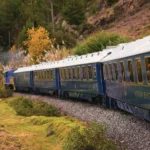
Board the Peru Rail Expedition train. This is the beginning of one of the most celebrated train journeys in South America — 90 km of rail descending through three distinct Andean ecological zones.
What you'll see from the train window:
- First 20 min: The train exits the high puna plateau around Cusco, crossing through eucalyptus forests and the first descending terraces of the Anta pampa
- 30–60 min: The Urubamba Valley begins to widen — a patchwork of Quechua farming villages, green agricultural fields and Inca terraces on the slopes above
- 60–120 min: The valley narrows into the Urubamba gorge. The river appears alongside the tracks, rushing green and white. The vegetation shifts from Andean dry forest to subtropical cloud forest. Bromeliads, orchids and ferns appear on the canyon walls
- 120–210 min: The final approach to Aguas Calientes through the narrowest section of the canyon. Machu Picchu mountain becomes visible briefly above the cloud forest canopy. The train pulls into Aguas Calientes station at river level
~10:30–11:00 hrs — Arrival in Aguas Calientes (2,040 m)
Arrival at Aguas Calientes station (Machu Picchu Pueblo). The guide coordinates the group and distributes the Machu Picchu entrance tickets. ~45 minutes free time before the bus:
- Breakfast/coffee at one of the cafés near the station (budget S/. 15–30 for coffee and pastries)
- Use of restrooms (bring your own toilet paper)
- Brief walk through the artisan market
- Secure your camera and valuables before boarding the bus
~11:30 hrs — Consettur Bus to Machu Picchu
The Consettur bus ascends the Hiram Bingham Road — 13 km of narrow switchback road climbing 400 meters from Aguas Calientes to the entrance of the Archaeological Park. Travel time: ~30 minutes. The road clings to the canyon wall with views of the cloud forest and the Vilcanota River below. This bus route was built by the Peruvian government in the 1940s to enable public access to Machu Picchu after Bingham's expeditions.
~12:00 hrs — Entry to Machu Picchu Archaeological Park (2,430 m)
After presenting passport and entrance ticket at the control gate, guided tour of Machu Picchu (~2 hours) on Circuit 2 — the most complete circuit for a first-time visit.
The guide covers the principal monuments:
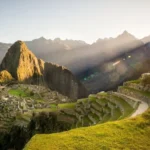
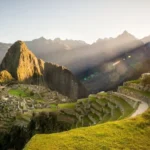
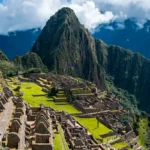
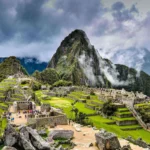
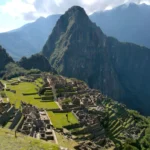
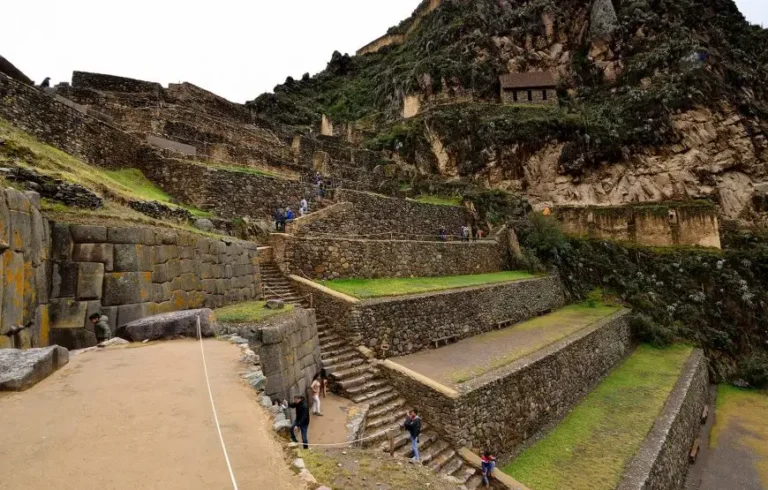
The Agricultural Sector — The first zone visible upon entry. Massive terraced platforms step down the mountain slope at angles of up to 80 degrees. The Inca drainage system, unchanged for 600 years, prevents the terraces from flooding even during the heaviest rainy season downpours. An estimated 100+ plant species were cultivated here in artificially created microclimates — a vertical laboratory of Andean agriculture.
The Sun Gate (Inti Punku) — The original main entrance of Machu Picchu, accessed from the Inca Trail. Pilgrims and messengers (chasquis) running the Qhapaq Ñan arrived here after days of walking through the cloud forest. The gate is aligned with the winter solstice sunrise — on June 21, light passes directly through the gate's trapezoidal window.
The Temple of the Sun (Torreón) — A semicircular tower of perfectly fitted granite built directly over a massive natural rock. The window on the eastern face is aligned with the winter solstice: at dawn on June 21, sunlight enters the window and illuminates a specific point on the floor. The construction precision required to achieve this astronomical alignment without modern instruments is extraordinary.
The Intihuatana — The "Hitching Post of the Sun" in Quechua. A carved granite gnomon used as a solar clock and calendar marker. On the spring and autumn equinoxes (March 21 and September 21), the Intihuatana casts no shadow at noon — the sun is directly overhead. No other known Intihuatana survived the Spanish conquest intact; the one at Machu Picchu was preserved by the city's abandonment and rediscovery.
The Temple of the Three Windows — Three massive trapezoidal windows overlooking the Sacred Plaza. The three windows correspond to the three worlds of Andean cosmology (Hanan Pacha — upper world; Kay Pacha — this world; Ukhu Pacha — lower world) and the three windows of the Inca origin myth (Tampu-tocco). The blocks used are among the largest in Machu Picchu — some exceed 3 meters in height.
The Temple of the Condor — A carved rock formation that replicates the outstretched wings of a condor in flight, with a condor head at the base. The condor is the sacred bird (Apu bird) of the Andean world, associated with the upper realm and the spirits of the mountains. The temple was also a ritual space for animal and agricultural offerings.
The Royal Neighborhood — The residential complex of the Inca and the Coya (royal queen), identifiable by the quality of the stonework: the finest-fitted blocks in the entire site, with joints so precise that a credit card cannot be inserted between them. Running water channels still flow through the royal bath fountains — fed by an Inca aqueduct that diverts water from a mountain spring above the site.
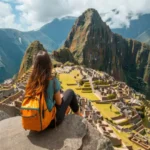
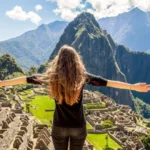
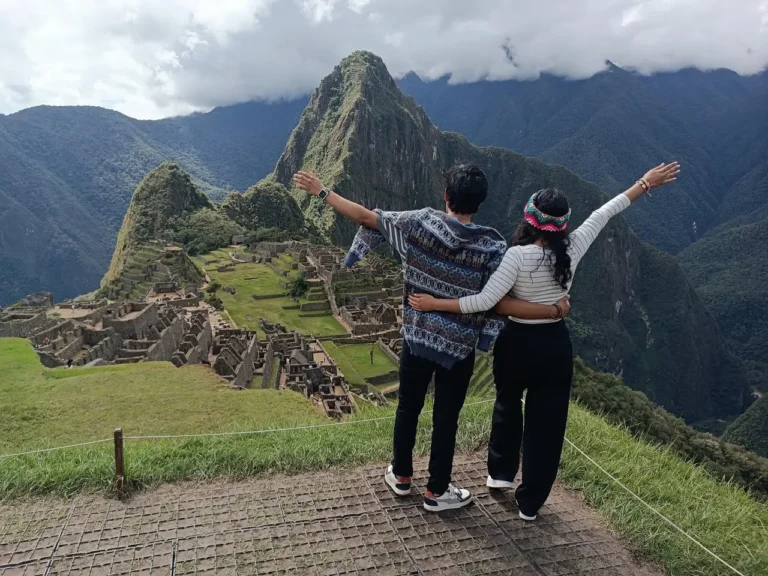
The Panoramic Viewpoints — Multiple terraces offer different angles on the citadel: the classic "postcard view" from the Sun Gate approach, the view of Huayna Picchu mountain rising behind the site, and the vertiginous view of the Urubamba river gorge 600 meters below.
~14:00 hrs — Free Time in Machu Picchu
After the guided tour, approximately 1.5–2 hours of free exploration before the bus descent:
- Walk toward the Sun Gate (Inti Punku) — a 45-min round trip with the classic mountain backdrop view
- Explore the less-visited sectors (the Prison Quarter, the Industrial Sector, the Cemetery)
- Photograph the citadel from different vantage points in the changing afternoon light
- Visit the museum building near the entrance (small but well-curated)
~16:00 hrs — Consettur Bus Down to Aguas Calientes
Bus descent from the citadel to Aguas Calientes (~30 min). Free time ~2 hours for lunch and optional activities in the town:
Lunch in Aguas Calientes (not included): dozens of restaurants face the Vilcanota River and the main plaza. A complete Peruvian lunch (menú del día: soup + main + drink) costs S/. 25–45. Restaurants by the river have the best price-to-quality ratio; avoid the tourist-oriented restaurants on the main pedestrian street.
Optional — Aguas Calientes Hot Springs (~S/. 20, not included): Natural thermal pools fed by underground hot springs on the hillside above the town. Multiple pools at different temperatures. Towel and swimsuit rental available at the site for a small fee. Ideal for relaxing after hours of walking on Inca stone.
Optional — Manuel Chávez Ballón Archaeological Museum (~S/. 22, not included): The archaeological museum closest to Machu Picchu, a 10-minute walk from the town center. Displays ceramics, tools and objects found in Machu Picchu's excavations — good context for what you just saw.
~18:00 hrs — Return Train Aguas Calientes → Poroy
The return Peru Rail Expedition train from Aguas Calientes. The 3.5-hour return journey is equally beautiful in the late afternoon — the canyon walls catch different light, and the ascent through the cloud forest has a different character than the morning descent.
~21:30 hrs — Arrival in Poroy — Transfer to Cusco
Private minivan transfer from Poroy station to your hotel in Cusco's historic center (~25 min). Arrival approximately 22:00 hrs. End of service.