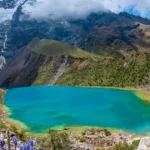
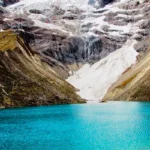
Cusco → Pacchanta → 7 Lagoons → Hot Springs → Cusco
04:30 h — Hotel pickup in Cusco (city center). Private vehicle departs immediately for the Ocongate district, approximately 100 km southeast of Cusco via the Interoceánica Sur highway (Route 26). The drive takes approximately 3 hours through progressively higher terrain — from the Cusco valley at 3,399m, up the Vilcanota valley toward the Andes divide, through the agricultural town of Urcos (3,100m), past the Laguna Urcos (a large blue lake in the valley floor), and up toward Ocongate and Tinki at the base of the Ausangate massif.
~07:30 h — Pacchanta community (3,990m). Breakfast at a local family home in Pacchanta — the last permanent settlement before the glacier. Breakfast typically includes egg dishes, bread, fruit, and hot drinks (coca tea or coffee). The Pacchanta community has maintained the trail access and lagoon entrance fee system as a form of community tourism income; your entrance tickets directly support this structure.
~08:00 h — Trek begins. The trail leaves Pacchanta's stone corrals and llama pastures and climbs immediately into open puna — the high-altitude Andean grassland ecosystem that covers the zone above 4,000m. The ichu grass (Stipa ichu) that covers the puna is the primary food source for all camelids in the region; the yellowish carpet of ichu stretches to the horizon, broken only by boulders and the occasional wetland (bofedal).
Fauna watch — the first 2 km. The lower puna approaching the first lagoon is where vicuñas are most consistently seen. Your guide points out the difference between vicuñas (wild, smaller, reddish-brown back / white underside) and alpacas (domesticated, larger, various colors, ear tags). Both graze on the same ichu grass at similar altitudes; vicuñas are protected and cannot legally be touched.
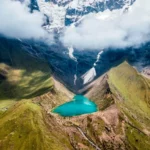
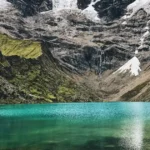
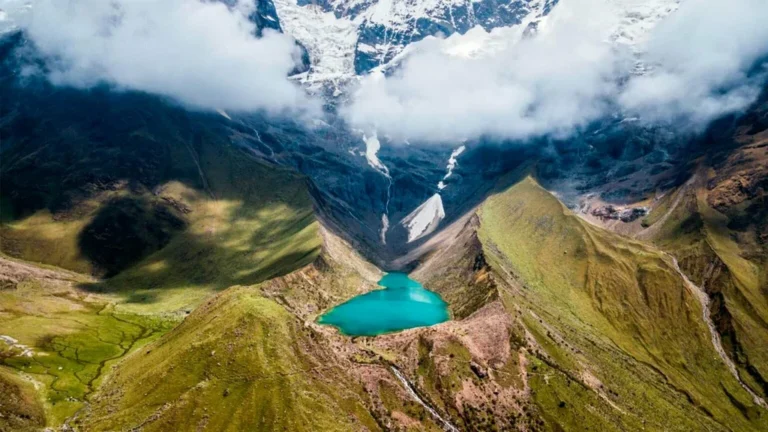
~09:00 h — Otorongo Macho Lagoon (4,450m) — "Male Jaguar Lake." The first of the seven, a deep blue-green lake fed directly by a glacial meltwater stream from the Ausangate face above. The name reflects the Andean practice of naming geographical features with paired male/female designations — the two Otorongo lagoons are conceived as a complementary pair in Quechua cosmology. The Apu Ausangate's southern face is directly visible above this lake — the permanent snowfield that feeds the glacier that feeds the stream that fills this lagoon.
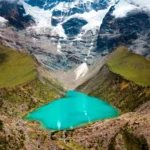
~09:30 h — Otorongo Hembra Lagoon (4,500m) — "Female Jaguar Lake." Set slightly higher than Otorongo Macho and to the east, with a different mineral composition yielding a more turquoise water color. The two Otorongo lakes sit in a natural glacial cirque — a bowl carved by a former glacier — and the trail between them crosses a moraine ridge with views south toward the Tinki plain.
~10:00 h — Puca Cocha (4,550m) — "Red Lake." The most visually striking of the seven. The high iron-oxide content of the surrounding bedrock gives the water a distinctly rust-red to orange hue in certain light conditions — most vivid in the morning sun between 09:00–11:00 h. The shore is bare glacial rock, with no vegetation; the contrast between the red water and grey stone and white glacier above is dramatic.
~10:30 h — Alqa Cocha (4,600m) — "Speckled Lake." A smaller lake with characteristic turquoise-grey coloring from glacial flour — fine mineral sediment suspended in the water from glacial grinding action. Glacial flour is what gives glacially-fed lakes their milky quality and distinctive colors; the concentration here produces a mottled appearance that justifies the "speckled" name.
~11:00 h — Qomer Cocha (4,650m) — "Green Lake." Elevated chlorite and algae content in the meltwater gives this lake its clear jade-green color. The shoreline is partially vegetated with cushion plants (Plantago rigida, Distichia muscoides) — the characteristic high-Andean bofedal plants that grow in wetland margins at 4,000–5,000m and are the preferred grazing of vicuñas and alpacas.
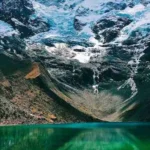
~11:30 h — Azul Cocha (4,700m) — "Blue Lake." Named for its pure deep-blue color — the clearest water in the sequence, with minimal suspended sediment. At 4,700m, the sky is also intensely blue from the thin atmosphere; the lake mirrors the sky and creates the effect of an unbroken blue vertical from lake surface to zenith. On windless mornings, the reflection of the Ausangate snowfield on the water surface is perfect.
~12:00 h — Pata Cocha (4,750m) — "Upper Lake." The highest and final lagoon, and the furthest from Pacchanta. The trail from Azul Cocha climbs the final 50m on loose rock and glacial debris. At Pata Cocha, the full panorama is visible: all seven lakes are either visible or implied in the basin below, the Ausangate summit rises directly above, and on clear days the Nevado Quelccaya ice cap is visible to the south — the largest tropical glacier in the world, 60 km southeast of Ausangate, currently retreating measurably each year due to climate change.
Rest at Pata Cocha: 20–30 minutes for photographs, rest, and altitude adjustment before the descent.
~12:30 h — Descent to Pacchanta. The return is approximately 1.5 hours retracing the ascent route. The descent is gentler in effort than the climb but requires attention on the rocky sections above Alqa Cocha.
~14:00 h — Lunch in Pacchanta. A full cooked meal at the community restaurant: typically soup (sopa de quinua or caldo de cordero), a main course with rice and vegetables, and herbal tea.
~15:00 h — Pacchanta hot springs (optional, S/. 20 PEN). The thermal pools are 5 minutes from the lunch restaurant. Multiple pools of different temperatures (30–40°C). Bring your bathing suit and a towel. The combination of high-altitude hiking and then soaking in hot springs is, predictably, one of the most pleasant post-trek experiences available near Cusco.
~16:00 h — Depart Pacchanta. Private vehicle returns to Cusco.
~18:30 h — Arrival in Cusco at your hotel.