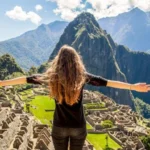
Machu Picchu Inca Citadel Peru
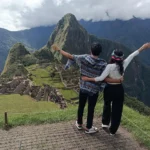
Machu Picchu Inca Ruins Andean Mountains
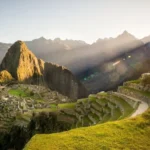
Machu Picchu Inca Site Peru
Machu Picchu Ruins Huayna Picchu Peru
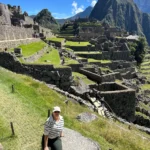
Machu Picchu Ruins Peru Travel
Machu Picchu Citadel Panoramic Peru
Machu Picchu Hero Panoramic Peru
Machu Picchu Tours Sacred Valley Peru
1 / 8

Short Inca Trail 2 Days to Machu Picchu: Wiñay Wayna & Sun Gate (2026)

Inca Trail 2 days / 1 night
  • Availability Daily departures
  • Transport Hotel pickup
  • Languages Spanish, English
  • Service type Not specified
  • Cancellation policy Not specified
  • Maximum altitude 2,720m (8,924 ft) m.s.n.m.

About this activity

The Classic Inca Trail takes 4 days. The Short Inca Trail covers the best 12 kilometers of it in 2 days — the stretch between Km 104 and Machu Picchu that passes through a cloud forest, two major Inca archaeological sites, and delivers you to the Sun Gate (Inti Punku) for the most iconic first view of the Lost City on the planet.

You begin at the Urubamba River, climb through the ceremonial complex of Chachabamba, continue to the elaborate terraces and water fountains of Wiñay Wayna (“Forever Young”), and arrive at the Sun Gate at altitude as the morning mist lifts over Machu Picchu below. The next morning, after a night at a hotel in Aguas Calientes, you enter the citadel for a full 2.5-hour guided tour before taking the train back to Cusco.

This is not a shortcut or a lesser version of the Inca Trail — it is the original route walked by the Incas to reach Machu Picchu, on original stone paving, through the best-preserved section of the entire trail.

Price: $450 USD per person. Hotel, train, permits, and all meals included from Day 1 lunch onward.


Why Choose This Tour?

  • Km 104 (2,100m) — trailhead on the Urubamba River
  • Chachabamba (2,050m) — ceremonial Inca complex
  • Wiñay Wayna (2,650m) — ‘Forever Young’ ruins, fountains & terraces
  • Inti Punku / Sun Gate (2,720m) — first view of Machu Picchu
  • Aguas Calientes (2,040m) — overnight hotel
  • Machu Picchu (2,430m) — guided citadel tour

Itinerary

01
Day 01

Cusco → Km 104 → Chachabamba → Wiñay Wayna → Sun Gate → Aguas Calientes

04:00 h — Hotel pickup in Cusco. Private transport approximately 1.5 hours northwest to Ollantaytambo (2,792m).

06:00 h approx. — Train from Ollantaytambo to Km 104 (45 minutes). Km 104 is not a town — it is a named stop along the Ollantaytambo–Aguas Calientes train line, identified by its distance from Cusco. It sits on the banks of the Urubamba River (2,100m), at the official trailhead of the Short Inca Trail. Your guide checks everyone's permits and passports with the SERNANP rangers at the control post.

07:30 h — Trail begins. The first 30 minutes follow the south bank of the Urubamba upstream, flat and easy, through riparian vegetation. You begin to see the change from dry inter-Andean valley scrub to cloud forest as the elevation starts to rise.

~08:00 h — Chachabamba (2,050m). The first major archaeological site. Chachabamba is a ceremonial complex positioned at the confluence of two rivers — a location the Incas consistently chose for sacred buildings, as rivers (and their meeting points) held deep religious significance in Andean cosmology. The site features fine-fitted stone structures, a central fountain group, and several enclosures. Archaeological evidence suggests it functioned as a ritual rest stop for groups approaching Machu Picchu from the Urubamba valley.

From Chachabamba, the trail begins to climb in earnest. The ascent to Wiñay Wayna gains approximately 600 vertical meters over 5 km — sustained uphill through cloud forest, with steps cut into the original Inca road where the gradient steepens. The cloud forest here is dense: orchids growing on tree branches, hummingbirds, and — if weather permits — views into the deep Urubamba gorge below. This section is the most physically demanding part of the day.

~11:30 h — Wiñay Wayna (2,650m). Lunch break at the campsite adjacent to the ruins. This is the most spectacular lunch stop on any trekking route from Cusco.

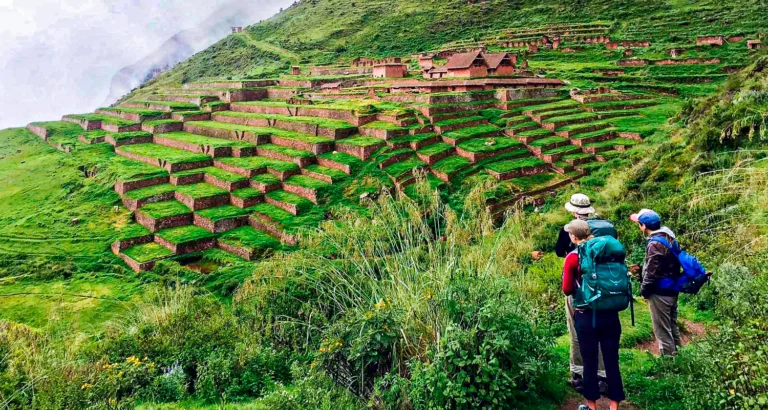
Wiñay Wayna translates as "Forever Young" in Quechua — the name comes from an orchid species (Epidendrum secundum) that flowers year-round on the site's terraces. The ruins consist of two main groups of structures separated by a central staircase: the lower group includes the Fountain Group (fuentes ceremoniales) — a sequence of 19 spring-fed ceremonial fountains that still flow today, carved from single stone blocks — and the Upper Group with a principal temple, a semicircular tower, and a row of residential structures. The scale and state of preservation are exceptional; Wiñay Wayna was not reconstructed after discovery but stabilized in its found condition.

The terraces cascade down the ridge for approximately 150 vertical meters. They served both agricultural and ceremonial purposes — their orientation and design follow the same principles as the terraces at Machu Picchu itself. From the upper temple, the view south into the Urubamba gorge and north toward the cloud-forested ridges is unobstructed.

~13:30 h — Resume hiking. The final 2 km from Wiñay Wayna to the Sun Gate is largely flat, following the original Inca road through cloud forest. This section is the easiest of the day.

~14:30 h — Inti Punku / Sun Gate (2,720m). The gateway through which the Inca road enters the Machu Picchu sanctuary. The name "Sun Gate" (Inti = sun, Punku = gate/door in Quechua) refers to the way the rising sun aligns with the gateway on winter solstice (June 21) — casting direct sunlight through the central opening onto Machu Picchu below. At equinoxes, the alignment produces a similar light-and-shadow effect on the citadel.

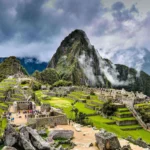
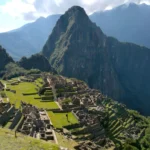
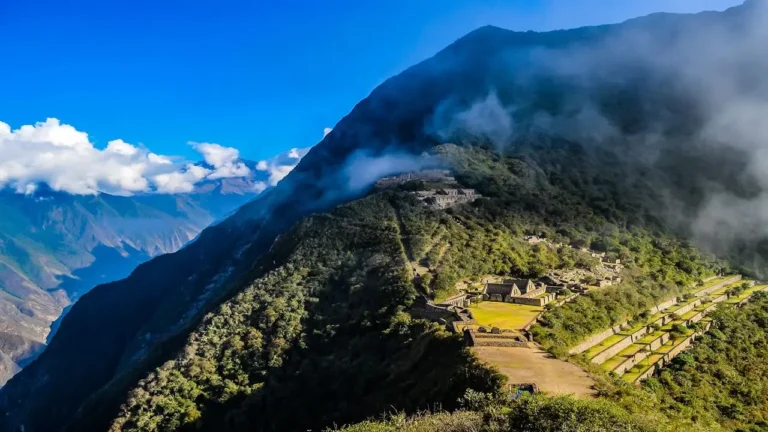
From the Sun Gate, the first full panoramic view of Machu Picchu opens: the agricultural terraces in the foreground, then the urban sector, then the steep drop of the Urubamba gorge on all sides, with Huayna Picchu (2,720m) rising sharply behind the ruins. This is the view at the same angle as the most widely reproduced photograph of Machu Picchu — taken from this exact spot. Weather permitting, you have 20–30 minutes here.

~15:30 h — Descent from the Sun Gate to Aguas Calientes (2,040m), approximately 45 minutes on a well-marked path. Note: the Sun Gate entrance to Machu Picchu closes in the afternoon, so the official citadel tour is deferred to Day 2.

~17:00 h — Check in at hotel in Aguas Calientes. Dinner included. Aguas Calientes (also called Machu Picchu Pueblo) is the base town for all Machu Picchu visitors. The town sits in a narrow valley at the bottom of the Urubamba gorge, surrounded by jungle-covered mountains. Optional: thermal baths at the edge of town (S/. 20 PEN, not included).


02
Day 02

Aguas Calientes → Machu Picchu → Train → Cusco

05:00 h — Breakfast at hotel.

05:30 h — Bus from Aguas Calientes up to Machu Picchu entrance (2,430m). The Consettur bus takes approximately 25 minutes on a switchback road carved into the mountainside. The entrance opens at 6:00 AM; being among the first groups in means cooler temperatures, softer morning light, and fewer crowds in the first hours.

~06:15 h — Machu Picchu. Your guide leads a 2.5-hour guided tour of the main citadel, covering: the Intihuatana stone (a carved astronomical instrument, the only unbroken one in Peru), the Temple of the Sun (a semicircular tower with a trapezoidal window aligned to the June solstice sunrise), the Royal Tomb, the Principal Temple, the Temple of the Three Windows (whose three trapezoidal windows overlook the Sacred Plaza), the Agricultural Terraces, and the residential and industrial sectors.

Machu Picchu was built under Pachacútec (9th Sapa Inca) around 1438–1450 CE as a royal estate and religious sanctuary — not as a city, not as a fortress, and not, according to current research, as an astronomical observatory. It was home to perhaps 500–750 permanent residents (priests, craftspeople, farmers) and used as a seasonal retreat for the Inca and his court. At its peak it had approximately 200 structures, running water via a 749-meter aqueduct, and 700 terraces covering 4 km of hillside. It was never found or destroyed by the Spanish; it was likely abandoned shortly after Pachacútec's death and the social disruption of the Spanish conquest. Hiram Bingham III reached it on July 24, 1911 — though local farmers had been cultivating its terraces for years before.

~09:00 h — Free time inside Machu Picchu. Options: walk the agricultural terraces for elevated views; climb to the Guardhouse (cabaña del guardia) for the classic full-panorama photograph; visit the Inca Bridge on the mountain path west of the citadel (30-minute round trip).

~11:00 h — Exit Machu Picchu. Bus down to Aguas Calientes. Free time for lunch (not included) along the main street.

~14:00–15:30 h — Train from Aguas Calientes to Ollantaytambo (approximately 1.5 hours through the Urubamba gorge cloud forest).

~17:00–18:00 h — Private transport from Ollantaytambo back to Cusco (3,399m).


What's included

Inclusions

  • Meals
    • 1 night hotel in Aguas Calientes (private room with breakfast)
    • Meals: box lunch and dinner (Day 1), breakfast (Day 2)
  • Tickets & Permits
    • Inca Trail permit (Km 104 → Machu Picchu)
    • Machu Picchu Circuit 2 entrance ticket
  • Guide
    • MINCETUR-certified bilingual guide (English/Spanish)
  • Transportation
    • Hotel pickup and drop-off in Cusco
    • Private transport Cusco ↔ Ollantaytambo
    • Train Ollantaytambo → Km 104 (Day 1)
    • Train Aguas Calientes → Ollantaytambo (Day 2)
    • Consettur bus up and down Machu Picchu (Day 2)
  • Other
    • First aid kit
    • Pre-trek briefing in Cusco

Frequently Asked Questions

How fit do I need to be for the Short Inca Trail?

Moderate fitness is sufficient for most healthy adults. The demanding section is the climb from Chachabamba to Wiñay Wayna — approximately 600 vertical meters over 5 km at low altitude (2,100m to 2,650m). There is no high-altitude exposure above 2,720m. Trekkers who walk regularly or do light cardio several times per week manage this comfortably. Spend at least 2 days in Cusco acclimatizing before the trek.

Do I need to book the permit in advance?

Yes — Inca Trail permits are limited to 500 per day total for all trail variants and sell out months ahead for peak season (June–August). We secure your permit the moment your booking is confirmed and payment processed. For June, July, and August dates, book 3–4 months in advance. Shoulder season (April–May, September–October) generally requires 4–6 weeks notice.

What's the difference between the Short Inca Trail and the Classic 4-Day Inca Trail?

The Classic 4-Day Inca Trail covers 43 km from Km 82 to Machu Picchu, crosses a 4,215m pass (Dead Woman's Pass), and involves camping. The Short Inca Trail covers the final 12 km from Km 104 — the Chachabamba to Sun Gate section — and ends with hotel accommodation in Aguas Calientes. You miss the 4-day trail's high-altitude section and two of its archaeological sites (Llaqtapata, Runcuracay), but you experience the same arrival at the Sun Gate and the same Wiñay Wayna ruins. For travelers with limited time or altitude concerns, the Short Inca Trail is the better choice.

Why is the trail closed in February?

The Peruvian Ministry of Culture closes the entire Inca Trail every February for annual maintenance and ecological recovery. This is a regulatory requirement, not operator policy — no agency can offer Inca Trail tours in February. The alternative during this month is the Salkantay Trek or the Inca Jungle Trail, both of which remain open.

Can I do the Short Inca Trail without a guide?

No. SERNANP regulations require that all trekkers on the Inca Trail be accompanied by a licensed, MINCETUR-certified guide registered with an authorized agency. Independent trekking on the Inca Trail is not permitted. There are SERNANP control posts at the Km 104 trailhead and at Wiñay Wayna that verify permits and guide credentials.

Will I see Machu Picchu from the Sun Gate?

On clear days (most of the dry season, April–October), yes — the full panoramic view from Inti Punku is unobstructed. In the rainy season or during afternoon cloud buildup (common from November onward), the citadel may be partially or fully covered by mist. The view is present but variable. Mornings are generally clearer than afternoons; the Day 2 visit inside the ruins is always accessible regardless of weather.

What happens to my luggage while I trek Day 1?

Day 1 is a single hiking day — you carry a daypack (20–25 liters) with your personal items and the lunch we provide. There is no porter service on this tour. Larger bags are stored at the hotel in Aguas Calientes, which our driver delivers directly before your arrival. You do not carry a full pack.

Is the Short Inca Trail suitable for children?

SERNANP does not permit children under 8 on the Inca Trail. For children aged 8–12, the hike is feasible but demanding — 12 km and 600m ascent on Day 1. Children aged 13 and above who have done multi-hour hikes typically manage well. Consult us before booking with children under 12 so we can assess suitability for your specific group.

What train do we take and does it matter which one?

Our tour uses the Expedition Train (Peru Rail or Inca Rail) for the return from Aguas Calientes to Ollantaytambo. The Expedition is the standard tourist train — comfortable, panoramic windows, ~1.5 hours. The Vistadome upgrade has larger roof windows and costs approximately $30–40 extra; we can arrange the upgrade on request. The Hiram Bingham (Orient Express) at $200+ is a separate luxury product not included in any tour package.

Can I add Huayna Picchu or Machu Picchu Mountain to the tour?

Yes, but these must be booked separately and in advance — they have their own permit quotas (Huayna Picchu: 400 per day in 2 shifts; Machu Picchu Mountain: 800 per day; Huchuy Picchu: ~600 per day). Huayna Picchu typically sells out 3–4 months ahead in peak season. The current prices are approximately $35–$75 USD depending on the circuit and platform. We can facilitate the booking if you inform us at least 2 months before your trek date.

Can’t find the answer to your question?

Get in touch with the experts at Travel Peru Tours for your inquiry.

Ask a question

Traveler reviews

From

$450 USD

Book now

Official endorsement

Associations & Certifications

We operate under the regulations and standards of Peru's leading tourism entities.

MINCETUR DIRCETUR GERCETUR ESSNA Marca Perú SUNAT Authorized Operator TripAdvisor GetYourGuide Viator WeTravel Y tú qué planes Peru Rail