Inca Trail 5 Days 4 Nights: The Leisurely Classic to Machu Picchu (2026)
-
Availability Daily departures
-
Transport Hotel pickup
-
Languages Spanish, English
-
Service type Not specified
-
Cancellation policy Not specified
-
Maximum altitude 4,215m (13,829 ft) m.s.n.m.
About this activity
The Inca Trail is a 44 km route from the Urubamba Valley to Machu Picchu, crossing a 4,215m mountain pass, traversing cloud forest, puna grassland, and subtropical jungle, and passing six major Inca archaeological sites before descending to the Sun Gate for the first view of the Lost City. It is the most famous trekking route in South America, and one of the most complete experiences of Andean archaeology and ecology anywhere in Peru.
The 5-day version is the same complete Inca Trail — every kilometer, every pass, every ruin — distributed over five days instead of four. The extra day allows you to linger at Wiñay Wayna’s ruins, spend unhurried time at Sayaqmarka and Phuyupatamarca, and arrive at the Sun Gate rested and ready for a full morning at Machu Picchu. This is the format for travelers who want to do the Classic Inca Trail properly rather than at a forced march pace.
Price: $720 USD per person. Includes all camping equipment, porter service, all meals from Day 1 lunch to Day 5 breakfast, and full permit bundle.
Why Choose This Tour?
- Km 82 / Piscacucho (2,750m) — trailhead
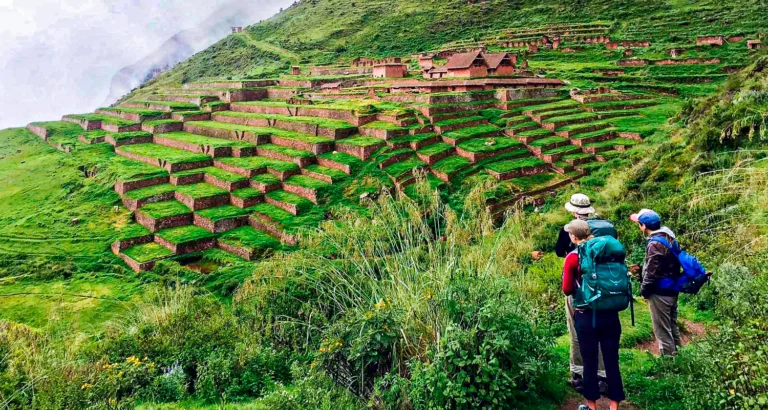
- Llaqtapata / Patallacta (2,840m) — Inca agricultural complex
- Warmiwañusca / Dead Woman’s Pass (4,215m) — highest point
- Runkurakay ruins (3,760m) — circular Inca watchtower
- Sayaqmarka (3,624m) — ‘Dominant Town’, cliff-top fortress
- Phuyupatamarca (3,640m) — ‘Town in the Clouds’, ceremonial fountains
- Wiñay Wayna (2,650m) — ‘Forever Young’, finest ruins on the trail
- Inti Punku / Sun Gate (2,720m) — first view of Machu Picchu
- Machu Picchu (2,430m) — full guided tour Day 5
Itinerary
Day 01
Cusco → Km 82 → Llaqtapata → Wayllabamba (3,000m)
06:00 h — Hotel pickup in Cusco. Private transport 2.5 hours northwest to Km 82 / Piscacucho (2,750m) — the official trailhead of the Classic Inca Trail on the north bank of the Urubamba River. SERNANP rangers check permits and passports at the control post.
The trail begins with a suspension bridge over the Urubamba River and immediately enters the Sacred Valley landscape: terraced hillsides, small Quechua communities, and distant snow-capped peaks. The first hour is relatively gentle — an introduction to the terrain before the climbing begins.
~09:00 h — Llaqtapata (2,840m). The first archaeological site on the trail. Llaqtapata (also called Patallacta) is a substantial agricultural and residential complex of 116 structures on terraced hillsides above the Cusichaca River. Recent research suggests it housed the workers who maintained this section of the Inca road network — a supply station and administrative center for the trail. The site was partially excavated by John Rowe in the 1940s and more systematically by Gary Ziegler and Hugh Thomson in 2003. Their survey also identified a secondary Llaqtapata site across the valley — visible from the trail — which may have had a direct sightline to Machu Picchu's Intihuatana stone during solstice.
Lunch is served at the Llaqtapata area — the first full meal with your cook team.
The afternoon continues uphill through the Cusichaca Valley to Wayllabamba (3,000m) — the last community on the trail and the last point with permanent water access before the high passes. Your camp is set up here; the cook team has arrived ahead of the group. Dinner is served as the sun sets over the valley.
Camp night 1: Wayllabamba (~3,000m)
Day 02
Wayllabamba → Warmiwañusca (4,215m) → Pacaymayo (3,600m)
06:00 h — Breakfast at camp. This is the hardest day on the trail — an 1,100m altitude gain over 5 km to the highest point on the route.
From Wayllabamba, the trail climbs steadily through dwarf forest and then opens into high-altitude grassland (puna). The ascent to Llulluchapampa (3,900m) — a high-altitude camping meadow — takes 2.5–3 hours. Condors are occasionally visible over the ridgeline above; Polylepis trees (queñua), among the highest-elevation trees in the world, dot the upper slopes.
Lunch stop at Llulluchapampa. The final push to the pass begins after lunch.
~14:00 h — Warmiwañusca (4,215m) — Dead Woman's Pass, the highest point on the Inca Trail and the named landmark for the entire route. The name Warmiwañusca translates as "dead woman" in Quechua, referring to the profile of the ridgeline as seen from Cusco, which resembles a woman lying supine. At 4,215m, the air holds approximately 60% of the oxygen available at sea level — most trekkers feel the altitude here regardless of their fitness level. The panorama from the pass extends north toward the Cordillera Urubamba and south back toward Wayllabamba and the Cusichaca Valley.
The descent to Pacaymayo (3,600m) is steep and rocky — 600m down over 2 km. This is the section most likely to generate knee pain; trekking poles are strongly recommended. Camp at Pacaymayo, in a valley sheltered from the prevailing winds.
Camp night 2: Pacaymayo (~3,600m)
Day 03
Pacaymayo → Runkurakay → Sayaqmarka → Phuyupatamarca (3,640m)
06:00 h — Breakfast at camp. This day visits three major archaeological sites across two mountain passes — the most archaeologically rich day on the trail.
The climb from Pacaymayo to the Runkurakay Pass (3,970m) takes 1.5–2 hours and is the second hardest ascent of the route. At the pass, you enter the Machu Picchu Historical Sanctuary — the protected area that encompasses the Inca Trail and Machu Picchu itself.
~09:00 h — Runkurakay (3,760m). A circular Inca structure interpreted as a tambo (way station) where messengers (chasquis) of the Inca postal system changed relay runners. The circular design is unusual — most Inca structures are rectangular — and may indicate a specific astronomical or ceremonial function. The views from Runkurakay, perched on a ridge above the jungle below, are excellent.
~11:00 h — Sayaqmarka (3,624m) — "Dominant Town." One of the most dramatically sited archaeological complexes on the trail: a multi-level stone city built on a narrow cliff promontory accessible only by a steep Inca staircase. Sayaqmarka was never fully excavated; the visible structures include ceremonial fountains, residential buildings, and observation platforms. The surrounding cloud forest is dense and silent. Lunch is served here.
From Sayaqmarka, the trail enters the longest continuous stretch of original Inca road paving on the route — wide stone causeways, perfectly fitted, with lateral drainage channels. This section passes through a tunnel cut directly through the rock by Inca workers.
~15:00 h — Phuyupatamarca (3,640m) — "Town in the Clouds." Named for the cloud forest that surrounds it on all sides, the site features five ceremonial fountains fed by mountain springs — still flowing today — arranged in a vertical sequence down the hillside. A solar observation platform provides views toward the Urubamba Valley when skies are clear. The site's water management engineering, which channels spring water from above through a series of precisely carved channels, is considered among the finest examples of Inca hydraulic architecture.
Camp is at Phuyupatamarca, adjacent to the ruins. On clear evenings, it is sometimes possible to see Machu Picchu in the distance from this campsite.
Camp night 3: Phuyupatamarca (~3,640m)
Day 04
Phuyupatamarca → Wiñay Wayna → Sun Gate → Aguas Calientes
06:00 h — Breakfast at camp. Today's descent through the most spectacular stretch of the Inca Trail.
A 900m staircase descent from Phuyupatamarca to the valley leads through increasingly lush cloud forest. This section has the highest orchid density on the trail — more than 300 orchid species have been recorded in the Machu Picchu Historical Sanctuary, with many concentrated in this upper cloud forest zone.
~08:30 h — Wiñay Wayna (2,650m). You have two hours here — the 5-day itinerary's most significant difference from the 4-day version.
Wiñay Wayna is the largest and most complete archaeological complex on the Inca Trail, and one of the finest examples of Inca architecture in all of Peru. The site consists of two main groups of structures:
The Upper Group includes a principal temple (with characteristic trapezoidal niches and double-jamb doorways indicating royal or sacred use), an astronomical observation platform, and several kallancas (long halls used for assemblies and ceremonies). The stonework uses the finest quality ashlar masonry — carefully fitted polygonal blocks without mortar — of any site on the trail.
The Lower Group is built around the Fountain Group (fuentes ceremoniales): a vertical sequence of 19 ceremonial water fountains carved from single stone blocks, fed by a continuous spring-water aqueduct. Every fountain still flows. The system was designed so that each fountain's overflow feeds the one below — a living demonstration of Inca hydraulic engineering that has functioned without maintenance for 600 years.
The terraces below Wiñay Wayna cascade 150 vertical meters down the ridge into the cloud forest. Their agricultural productivity was likely supported by the same aqueduct system that feeds the fountains.
~11:00 h — Lunch at Wiñay Wayna campsite. The final Inca Trail porter check-off happens here; you say goodbye to the porter team before the last section.
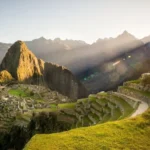
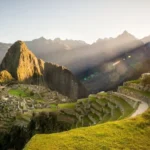
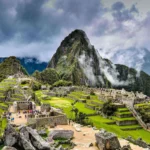
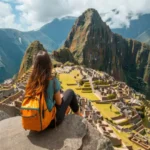
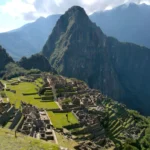
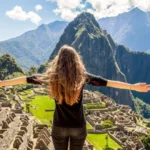
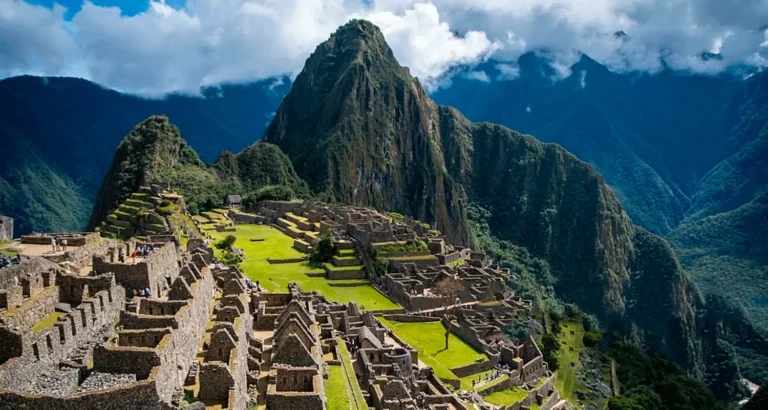
~12:30 h — Inti Punku / Sun Gate (2,720m). The gateway to the Machu Picchu sanctuary. The trail arrives at the Sun Gate in full midday light — ideal conditions for the first panoramic view of Machu Picchu spread below. The agricultural terraces, the urban sector, Huayna Picchu's dramatic peak behind the ruins, and the deep V of the Urubamba gorge on three sides are all visible from the gate.
~13:30 h — Descent from the Sun Gate into Machu Picchu. An optional 30-minute walk to the Sun Gate entrance of the citadel (different from the main entrance). Time permitting, a brief orientation tour inside the ruins before closing (5:30 PM).
~15:30 h — Bus down to Aguas Calientes (2,040m). Hotel check-in, hot shower, dinner at a local restaurant (on your own or at the hotel, depending on your package).
Hotel night 4: Aguas Calientes

Day 05
Aguas Calientes → Machu Picchu → Train → Cusco


05:00 h — Breakfast at hotel.
05:30 h — Bus to Machu Picchu (25 minutes). First entry group of the day.
~06:00 h — 2.5-hour guided tour of Machu Picchu. Sites covered: Intihuatana stone (the only unbroken solstice-alignment gnomon in Peru), Temple of the Sun, Royal Tomb, Principal Temple, Temple of the Three Windows, Sacred Plaza, residential and industrial sectors, and agricultural terraces.
Key historical context: Machu Picchu was constructed under Pachacútec (9th Sapa Inca, r. 1438–1471 CE) as a royal estate and religious sanctuary — not a city and not a fortress. It housed approximately 500–750 permanent residents. The entire complex required an 749-meter aqueduct, 700 terraces on 4 km of hillside, and an estimated 3,000 workers over 30 years to construct. It was likely abandoned within 100 years of construction following the political disruptions of the Spanish Conquest. Hiram Bingham III documented it for the outside world on July 24, 1911.
~09:00 h — Free time inside Machu Picchu. Recommended: the Guardhouse (cabaña del guardia) for the full panorama photograph; the Inca Bridge (30-minute round trip west of the citadel); agricultural terrace circuit.
~11:00 h — Exit. Bus to Aguas Calientes. Lunch on your own.
~14:00–15:30 h — Train Aguas Calientes → Ollantaytambo (1.5 hours through Urubamba gorge).

~17:30–18:00 h — Private transport back to Cusco.
What's included
Inclusions
-
Meals
- All meals: Day 1 lunch through Day 5 breakfast (4 breakfasts, 4 lunches, 4 dinners)
-
Tickets & Permits
- Inca Trail permit (Km 82 → Machu Picchu, SERNANP)
- Machu Picchu Circuit 2 entrance ticket
-
Guide
- MINCETUR-certified bilingual guide
- Assistant guide for groups of 9 or more
-
Transportation
- Hotel pickup and return to Cusco
- Private transport Cusco ↔ Km 82 and Ollantaytambo ↔ Cusco
- Return train Aguas Calientes → Ollantaytambo

- Consettur bus to/from Machu Picchu (Day 5)
-
Equipment
- 3 nights camping in double-occupancy mountain tents (4P tents, 2 per tent)
- Camping equipment: tents, sleeping bag, camp mattress
- Porter service: carries tents, kitchen gear, communal equipment
- Dining tent with folding tables and chairs
-
Accommodation
- 1 night hotel in Aguas Calientes

-
Other
- Vegetarian option available at no extra charge
- Emergency oxygen bottle
- First aid kit
- Biodegradable soaps and detergents
- Pre-trek briefing in Cusco
- Secure luggage storage in our Cusco office during trek
Frequently Asked Questions
How is the 5-day Inca Trail different from the 4-day version?
Both cover the same 44 km route from Km 82 to Machu Picchu. The 5-day version distributes the distance over one extra hiking day, reducing the average daily distance and allowing more time at the archaeological sites — particularly Wiñay Wayna, which receives a dedicated half-day rather than a rushed late-afternoon stop. The total cost is slightly higher ($720 vs $680 for our 4-day) because it adds one extra night of camping, cook, and guide service.
Do I need to carry my own gear?
No. The porter team carries all camping equipment (tents, kitchen, tables, chairs, food). You carry only your personal daypack (recommended 20–25 liters) with your clothing, water, snacks, and personal items. An optional personal porter can carry your main bag for an additional fee.
What altitude do we sleep at?
Night 1: Wayllabamba (~3,000m). Night 2: Pacaymayo (~3,600m). Night 3: Phuyupatamarca (~3,640m). Night 4: Hotel in Aguas Calientes (~2,040m). The progression from 3,000m → 3,600m → 3,640m → 2,040m means you are at altitude for three nights before descending significantly; this gradual pattern aids acclimatization.

Is it safe to do the trail if I have mild altitude concerns?
The 5-day Inca Trail's maximum altitude is 4,215m (Dead Woman's Pass, Day 2). Everyone in the group carries altitude medication; the guide carries emergency oxygen. However, altitude illness is individual and cannot be entirely predicted. Spend at least 3–4 days in Cusco before the trek, avoid alcohol the day before, stay hydrated, and ascend slowly. If you experience severe symptoms (severe headache, vomiting, confusion), the guide will assist in descent.
What happens to luggage I don't bring on the trek?
Bags left in Cusco are stored securely in our office at no charge. Only bring what fits in a 20–25 liter daypack on the trail; your main luggage remains in Cusco until you return.
Can children do the 5-day Inca Trail?
SERNANP regulations prohibit children under 8 on the Inca Trail. Children aged 8–12 may participate if physically active and comfortable with sustained uphill hiking. For families with younger children, the Short Inca Trail 2 Days is a better alternative (lower altitude, no camping, hotel accommodation).
What food is served during the trek?
The camp cook prepares three full meals per day from Day 1 lunch. Breakfasts typically include hot cereal, eggs, bread, fruit, and hot drinks. Lunches are served hot at designated rest points and include soup, a main course, and dessert. Dinners at camp are multi-course with soup, main, and dessert. Vegetarian options are provided for all meals if requested at booking.
What permits do you arrange, and what documents do I need?
We arrange: (1) Inca Trail SERNANP permit — requires your full legal name and passport number exactly as printed. (2) Machu Picchu entrance ticket — Circuit 2. Bring the same original passport you used for booking to the Km 82 trailhead check post; photocopies and digital copies are not accepted.
Can’t find the answer to your question?
Get in touch with the experts at Travel Peru Tours for your inquiry.
Ask a questionTraveler reviews
Did you take this tour?
Share your experience with other travelers
Let our local experts help you plan your perfect adventure in Peru.
Write to us and we'll reply within 24 hours.
Related Tours
Related trips you might be interested in
From
$720 USD
Official endorsement
Associations & Certifications
We operate under the regulations and standards of Peru's leading tourism entities.