08:30 hrs — Hotel pickup in Cusco. The South Valley route heads southeast on the Cusco–Puno highway, passing through the chicharron town of Saylla (~15 min from Cusco), where roadside restaurants have served crispy pork since colonial times. Free time in Saylla if the group wishes (~15 min stop).
Tipon: The Inca Water Temple (3,200 m)
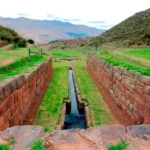
Located 27 km southeast of Cusco, Tipon is the most technically sophisticated hydraulic engineering project in the Inca Empire — and one of the least visited major sites in the Cusco region.
The complex was built during the reign of Yahuar Huacac (early 15th century) and expanded by Huiracocha. Unlike Machu Picchu or Ollantaytambo which served defensive and ceremonial functions, Tipon was dedicated almost entirely to water management and agricultural production at scale.
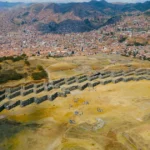
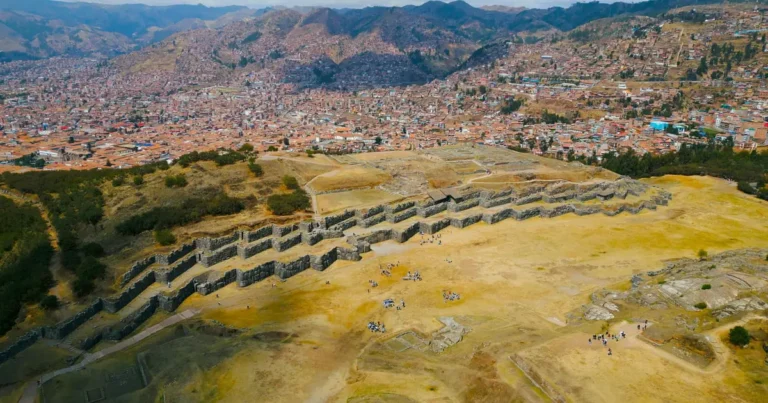
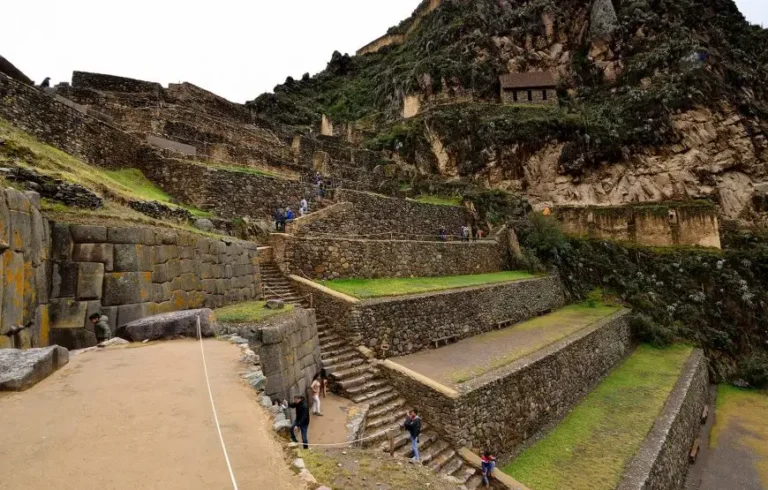
The 12 terraces: twelve massive agricultural terraces, each up to 3 m tall, rise in sequence up the valley wall. Unlike standard Inca agricultural terraces (which were largely decorative at ceremonial sites), Tipon's terraces are still cultivated today by the surrounding community — a continuous 600-year agricultural succession. Corn, quinoa, potatoes and medicinal plants grow on the same soil prepared by Inca labor.
The irrigation system: water arrives from the Pukara spring via a carved stone aqueduct channel nearly 2 km long. At Tipon, the channel branches into a network of 11 separate water distribution canals serving each terrace individually. The flow rate is regulated by carved stone gates — a simple but precise control system that archaeologists classify as a masterpiece of Inca hydraulic engineering. The water channels never clog, never erode and never freeze — the Inca engineers calibrated the angle of each canal to maintain optimal flow without erosion pressure.
The main fountain: at the center of the site, a carved stone fountain with 4 spouts discharges water at equal pressure from all 4 channels simultaneously — demonstrating that the Incas understood fluid dynamics and equal-pressure distribution without formal physics.
The colonial mansion: near the site entrance, a well-preserved colonial hacienda building (1650) still stands — built by a Spanish encomendero who used Tipon's water channels to irrigate his own crops. The juxtaposition of colonial architecture against Inca engineering at a single location is unique in the Sacred Valley.
BTP partial ticket: Tipon is covered by the partial Boleto Turístico (S/. 70 PEN, valid 2 days). Purchased at the site gate if not already held.
Pikillaqta: The Pre-Inca Wari City (3,200 m)
7 km past Tipon, Pikillaqta is the largest pre-Inca settlement in the Cusco region — and one of the best preserved Wari culture cities in South America.
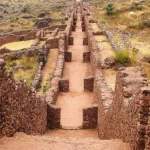
The Wari culture (600–1000 CE): the Wari (also called Huari) were the predecessor empire to the Inca, centered in Ayacucho (central Peru) and expanding throughout the Andes between 600 and 1000 CE — approximately 400 years before the Inca Empire. Where the Inca built in fitted stone, the Wari built in adobe brick. Where Inca cities were organic in layout, Wari cities followed rigid orthogonal grid plans — long parallel corridors, rectangular compounds and uniform room dimensions assigned by the administrative state.
The compound: Pikillaqta ("flea city" in Quechua — likely a Spanish-era nickname) covers approximately 2 km² with over 700 structures. The cells are uniform in size (approximately 4m × 4m) — archaeologists interpret this as barracks or controlled housing for a state-assigned labor force (mitayoc). No domestic hearths have been found inside the cells, suggesting occupants were fed communally — a state management model the Inca later adopted.
The plaster coating: the outer walls of Pikillaqta's buildings were originally coated with white gypsum plaster, making the city visible from the surrounding hillsides as a gleaming white grid. When the Wari abandoned the site (~1000 CE), they deliberately destroyed doorways and sealed entrances — suggesting a controlled withdrawal rather than a conquest or abandonment.
The defensive lagoon: adjacent to the south wall, the Laguna Lucre (also called Huacarpay) forms a natural water barrier. Inca engineers later widened and shaped the lagoon as part of a road improvement along the Qhapaq Ñan — the royal road south toward Puno and Lake Titicaca.
Transition to Inca: there is archaeological evidence that the Inca studied and adapted Wari administrative models — particularly the grid compound system and the mitayoc labor draft. Pikillaqta is one of the few places where the continuity between the two cultures is physically documented.
BTP partial ticket: Pikillaqta is covered by the same partial BTP (S/. 70 PEN) as Tipon.
Andahuaylillas: The Sistine Chapel of the Americas (3,100 m)
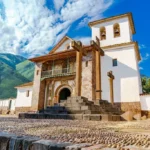
10 km past Pikillaqta, the village of Andahuaylillas appears as a quiet colonial square shaded by ancient trees — and at its center stands a church described by UNESCO consultants as the richest Baroque interior in the Americas outside of Spain.
San Pedro Apóstol de Andahuaylillas was built by the Jesuits between 1570 and 1620 as a reducción church — a Spanish colonial institution that forcibly concentrated dispersed Quechua communities into grid-plan towns for easier taxation and conversion. The exteriors of reducción churches were typically plain; the interiors were designed to overwhelm Andean converts with the wealth and power of the new faith.
The interior: the nave is covered floor-to-ceiling with Cusco School oil paintings, gilded ceilings, carved wooden choir stalls and four large Baroque altarpieces. The main entrance arch is painted with a Last Judgment in the Mannerist style — one of the finest surviving examples of 17th-century colonial religious art in South America. The floor is original Spanish azulejo tile. The baptismal font (1620) is hand-carved local limestone.
The Cusco School (Escuela Cusqueña): the paintings that fill Andahuaylillas represent the Cusco School style — a regional synthesis of Spanish Baroque technique and Andean subject matter, developed by indigenous and mestizo painters trained by Jesuit missionaries in the 17th–18th centuries. Cusco School art is distinguished by golden backgrounds (borrowed from Byzantine tradition via Spain), flat perspective, and the insertion of Andean imagery (hummingbirds, coca plants, cuy) into European biblical scenes. The Andahuaylillas church contains the densest surviving concentration of Cusco School paintings outside of the Cusco Cathedral itself.
Entrance fee: approximately S/. 10–15 PEN (paid at the church door, separate from BTP).
Huasao Wetlands: Ecological Recovery + Forest of Sculptures
The final stop on the South Valley circuit, Huasao is the ecological counterpart to the 3 archaeological sites — a wetland and park that has undergone active restoration since 2010.
The wetlands: the Huasao area sits at the confluence of seasonal streams from the surrounding hills, creating a marsh zone that was historically drained for agricultural use in the 20th century. The ecological recovery project since 2010 has re-established the wetland hydrology and reintroduced native aquatic plants — totora reeds, puya plants and Andean sedges — creating habitat for migratory birds.
Bird species: the Huasao wetlands host 30+ documented bird species including:
- Andean coot (Fulica ardesiaca) — black waterbird, red bill, common on wetland margins
- Yellow-winged blackbird (Agelasticus thilius) — male is black with bright yellow wing patches
- Puna ibis (Plegadis ridgwayi) — dark iridescent wading bird, curved bill
- Andean lapwing (Vanellus resplendens) — grey with green wing sheen, loud alarm call
- Torrent duck (Merganetta armata) — visible on fast-running streams adjacent to the wetlands
The Forest of Sculptures: within the park, local artisans have created a collection of large-scale wooden sculptures using fallen eucalyptus and native timber — abstract and figurative forms representing Andean mythology, local flora and fauna. The sculptures are placed along walking paths through the reed beds.
What to expect: Huasao is not a formal archaeological site and is less visited than Tipon and Pikillaqta. It has a park admission fee of approximately S/. 5–10 PEN. The walking paths are flat and suitable for all fitness levels. Allow 45–60 minutes.